AGV vs Forklift: Which Is Cheaper for Thai Warehouses in 2026?
Comparing AGV vs forklift for Thai warehouses in 2026 — 5-year TCO, ฿1.2–3.5M price range, 50% less labor, 80% fewer accidents, with a real case study from Amata Industrial Estate.
Forklift rental rates in Amata City Chonburi and WHA Eastern Seaboard have climbed from ฿18,000/month in 2020 to ฿28,000–35,000/month in 2026, while wages for licensed forklift operators have risen 35% over the past five years. As a result, many Thai warehouse managers are asking the same question — AGV vs forklift: which is really cheaper? According to IFR World Robotics 2024, Thailand’s AGV/AMR installations grew 38% year-on-year in 2024, the highest in ASEAN. This article works through a real 5-year TCO calculation, compares popular models, presents a Thai 3PL case study that switched successfully, and warns about the mistakes that make AGV projects fail.
TL;DR — AGV vs Forklift in 30 Seconds
An AGV costs ฿1,200,000–3,500,000 per unit versus ฿650,000–950,000 for a new electric forklift, making the AGV look 2–4x more expensive. But over a 5-year TCO, an AGV saves ฿1.8–2.6 million per unit thanks to no operator wages (฿380,000/year per shift × 2 shifts = ฿760,000/year), 60% lower fuel/electricity costs, and 80–95% fewer accidents. Thai warehouses with throughput above 300 pallets/day running two or more shifts recoup an AGV in 28–42 months. Brands actually deployed in Thailand in 2026 include MiR (Denmark), Quicktron (China), AGILOX (Austria), and KUKA Swisslog. The number-one mistake is buying an AGV before auditing the warehouse floor — surface unevenness beyond 5 mm/meter throws off navigation and kills the ROI. Most warehouses under 3,000 sq m should still use electric forklifts or small AMRs instead.
AGV vs Forklift — the Basic Differences You Need to Understand Before Deciding
Forklifts have been part of Thai warehouses for more than 60 years. There are two main types: diesel/gas forklifts (counterbalance) and electric forklifts. They require an operator holding a forklift license per Ministry of Labour standards, travel at an average of 8–12 km/h, and can lift loads from 1.5 to 5 tons.
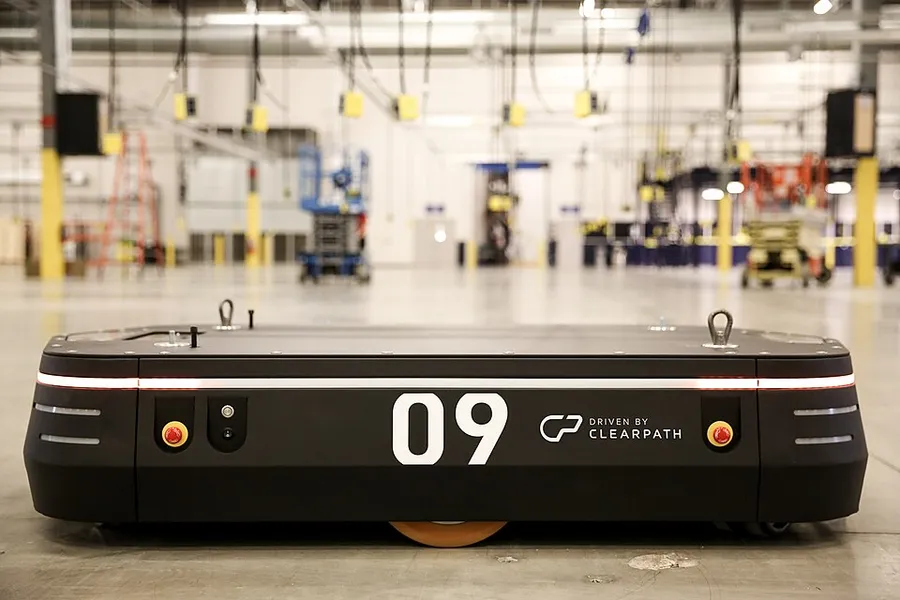
An AGV (Automated Guided Vehicle) is a driverless transport vehicle that follows a predefined path — magnetic tape, QR codes on the floor, or SLAM-based navigation with LiDAR for newer AMRs (Autonomous Mobile Robots). It runs continuously for 22 hours a day, leaving 2 hours for automatic charging, and connects to the WMS (Warehouse Management System) via REST API.
| Factor | Electric Forklift | AGV/AMR |
|---|---|---|
| Starting price (฿) | 650,000–950,000 | 1,200,000–3,500,000 |
| Operator | License required | Not needed |
| Working hours/day | 8–10 (1 shift) | 22 (24/7 minus charging) |
| Average speed | 8–12 km/h | 5–7 km/h |
| Accident rate | 1.4 per 100,000 hrs | 0.1–0.3 per 100,000 hrs |
| Maintenance per year (฿) | 45,000–80,000 | 60,000–120,000 |
| Lifespan | 7–10 years | 8–12 years |
| Flexibility to change layout | High | Low–medium |
The figures above are compiled from actual installations in Amata City Chonburi, WHA Mega Logistics Bang Pa-in, and Frasers Property Logistics Park during 2024–2026. The clear takeaway is that an AGV has a higher upfront cost but does 2.5x the work of a single-shift human-driven forklift with no operator wages.
5-Year TCO — Is an AGV Really Cheaper Than a Forklift?
Many people think AGVs are too expensive because they only look at the purchase price, but Total Cost of Ownership (TCO) over five years is the more accurate measure. The table below compares per-unit TCO for pallet-move work running two shifts (16 hours/day) in an 8,000 sq m warehouse.
| Item | Electric Forklift (5 yrs) | AGV (5 yrs) |
|---|---|---|
| Capex (purchase) | ฿800,000 | ฿1,800,000 |
| Operator (2 shifts × ฿380,000/yr) | ฿3,800,000 | ฿0 |
| Electricity/fuel | ฿320,000 | ฿180,000 |
| Maintenance | ฿320,000 | ฿420,000 |
| Battery Replacement | ฿180,000 | ฿250,000 |
| Insurance + Accident Cost | ฿420,000 | ฿80,000 |
| Fleet software (avg per unit in a 5-unit fleet) | ฿0 | ฿240,000 |
| Total 5-year TCO | ฿5,840,000 | ฿2,970,000 |
The difference: an AGV saves ฿2,870,000 per unit over 5 years, or about ฿574,000/year on average. This figure is based on wages for licensed forklift operators in Thai industrial estates in 2026 — a base of ฿520–600/day plus overtime, social security, and bonus, totaling roughly ฿380,000–420,000/year per shift.
That said, an AGV’s TCO only pays off when you run two or more shifts with throughput above 300 pallets/day. For a single-shift, low-throughput warehouse, a forklift is still more economical because the operator is already fully utilized within one shift and the capex is lower.
Another variable many overlook is accident cost. Thailand’s Social Security Office and major insurers report that a warehouse forklift accident costs ฿85,000–250,000 on average per incident (treatment + repairs + downtime). AGVs equipped with safety LiDAR compliant with ISO 3691-4 reduce accident frequency by 80–95%.
Which AGV Brand Fits Thai Warehouses in 2026?
The AGV/AMR market in Thailand in 2026 has players from Europe, China, and Korea, each with different strengths. Warehouse managers should choose based on their actual use case.
- MiR250 / MiR600 — payload 250–600 kg, ฿1,400,000–2,200,000 per unit. The easiest AMRs to use, deployable in 2–3 weeks. Part of the Universal Robots Group, with a user-friendly fleet manager. Well suited to e-commerce and light manufacturing.
- Quicktron Q5 / M3 — payload 300–500 kg, ฿1,200,000–1,600,000 per unit. A Chinese brand installed at Lazada’s Eastern Bangkok Hub and JD Central WHA. Good value and supports large fleets of 50+ units.
- AGILOX ONE / ONE-S — payload 1,000–1,500 kg, omnidirectional, ฿2,200,000–3,200,000 per unit. An Austrian brand strong in pallet moves at Tier-1 automotive plants around Amata City.
- KUKA KMP 1500 / KMP 600 — payload 600–1,500 kg, ฿2,500,000–3,500,000 per unit. Integrates well with KUKA robotic arms in a robot cell. Suited to BMW, Mercedes-Benz, and Toyota plants.
- Hai Robotics HaiPick A42T — an ACR (Autonomous Case-handling Robot), ฿3,200,000–4,200,000. Used at the Pomelo Fashion DC for bin-to-person picking on 5–10 meter high racks.
All models above are approximate per-unit prices — see AGV prices broken down by type (tugger, forklift, AMR, G2P) along with hidden costs and full ROI in the 2026 factory AGV pricing guide.
For palletizing work on production lines that must connect to FANUC or ABB robotic arms, Thai integrators typically recommend AGILOX or KUKA KMP, because their communication protocols support the PROFINET and EtherCAT standards that industrial robots use.
Case Study: a 3PL in Bang Pa-in Replaced 6 Forklifts With 4 AGVs
A 3PL provider at Frasers Property Logistics Park in Bang Pa-in (12,000 sq m, 8,500 SKUs stored, throughput 4,200 order lines/day) ran six electric forklifts across two shifts, with annual costs as follows:
- Wages for 12 operators (6 units × 2 shifts) = ฿4,560,000/year
- Forklift rental + maintenance = ฿2,160,000/year
- Accident and insurance claims, on average = ฿320,000/year
- Total = ฿7,040,000/year
In Q3 2024, management decided to invest in four Quicktron M3 AGVs plus fleet management software, a total budget of ฿9,800,000 (capex).
After deployment was completed in Q1 2025, the results over the first 12 months were:
- Reduced operators from 12 to 3 (supervisor + maintenance) = ฿3,420,000/year saved
- Increased throughput from 4,200 to 6,800 order lines/day (+62%) because AGVs can run the night shift
- Reduced pick error from 1.2% to 0.18% thanks to direct WMS integration
- Reduced accidents to zero in the first 12 months (versus 4–6 per year before)
- First-year net saving = ฿3,750,000 → estimated payback in 32 months
The success factor management shared was doing a pre-AGV audit three months ahead: they repaired 8 spots of concrete floor that fell below standard (flatness >5 mm/meter), an extra ฿180,000, and upgraded the WMS to support REST API for another ฿650,000 — costs many warehouses overlook that end up delaying or sinking the project.
Mistakes That Make AGV Projects Fail
From interviews with five AGV/AMR integrators in Thailand, 30–40% of AGV projects during 2022–2024 suffered slower-than-planned payback or had to be abandoned. The main mistakes are as follows:
- Not auditing the floor before buying — LiDAR-based AGVs need floor flatness within 5 mm/meter. Old concrete or cracked floors cause localization errors, jolting units, and sensor damage. Floor repairs run ฿200,000–800,000 per 8,000 sq m.
- Buying an AGV without upgrading the WMS — an AGV only performs at full capacity when the WMS can dispatch tasks via API in real time. An old WMS running on Excel or batch database updates leaves the AGV waiting for tasks, with utilization below 40%.
- Choosing the wrong payload — many warehouses buy a 250 kg-payload AGV and then try to lift an 800 kg pallet, burning out the motor and wasting the capex. Correct payload calculation must include the pallet + goods + a 20% margin.
- Not planning charging infrastructure — a fleet of 6+ units needs 2–3 opportunity charging stations drawing 3-phase 32A per station. Older warehouses on single-phase power must invest an extra ฿250,000–600,000 in a transformer.
- Not training the operations team — AGVs need a supervisor who understands the fleet management dashboard. Teams used to manual operation reject the new system and work around it by switching off the AGVs and going back to forklifts.
Most integrators recommend starting with a pilot of 1–2 AGVs for 3–6 months to test the workflow and train the team before scaling to a full fleet.
Conclusion: Should Thai Warehouses Choose AGVs or Forklifts?
The answer depends on three main variables — warehouse size, throughput, and number of shifts. If your warehouse is larger than 5,000 sq m, runs throughput above 300 pallets/day, and operates two or more shifts, an AGV saves ฿1.8–2.6 million per unit over five years versus a forklift and pays back in 28–42 months. If your warehouse is smaller than that or runs only one shift, an electric forklift remains the lower-TCO option.
The safest approach is to start with a pilot of 1–2 units in the most repetitive lane, evaluate for 3–6 months, then scale the fleet based on real results. Don’t forget to audit the floor, upgrade the WMS, and choose an integrator with genuine references in Thailand — Frasers Logistics Park, WHA Mega Logistics, and Amata City are areas with real installations you can visit. As a next step, calculate your ROI with the tool on the AGV/AMR pricing page with full specs for every type and compare pricing against the brand that fits your use case before finalizing your investment budget.
Related FAQ
AGVs cost more than forklifts, so why are they more worthwhile in the long run?
An AGV starts at ฿1,200,000–1,800,000 per unit versus ฿650,000–950,000 for a new forklift, so it looks more expensive. But over a 5-year TCO, an AGV saves ฿1.8–2.6 million per unit because it needs no operator (a wage of ฿380,000/year per shift), cuts accidents by 80%, and runs 22 hours a day with no overtime.
Is an AGV worthwhile for a Thai warehouse smaller than 3,000 sq m?
A warehouse under 3,000 sq m with throughput below 200 pallets/day usually isn't worth an AGV, because the fixed cost of fleet management software (฿800,000–1,500,000) spread across a single unit pushes payback beyond 5 years. A better option is an electric forklift plus a reach truck, or starting with 1–2 AMRs alongside manual forklifts.
How safely can an AGV operate in a warehouse where people are also walking around?
The latest 2026 AGVs use 360° LiDAR plus a safety scanner compliant with ANSI B56.5 and ISO 3691-4, stopping automatically when they detect a person or obstacle within 1.5–2.5 meters. Their accident rate is 80–95% lower than human-driven forklifts, according to data from WHA Logistics and Frasers Property Logistics Park in 2024–2025.